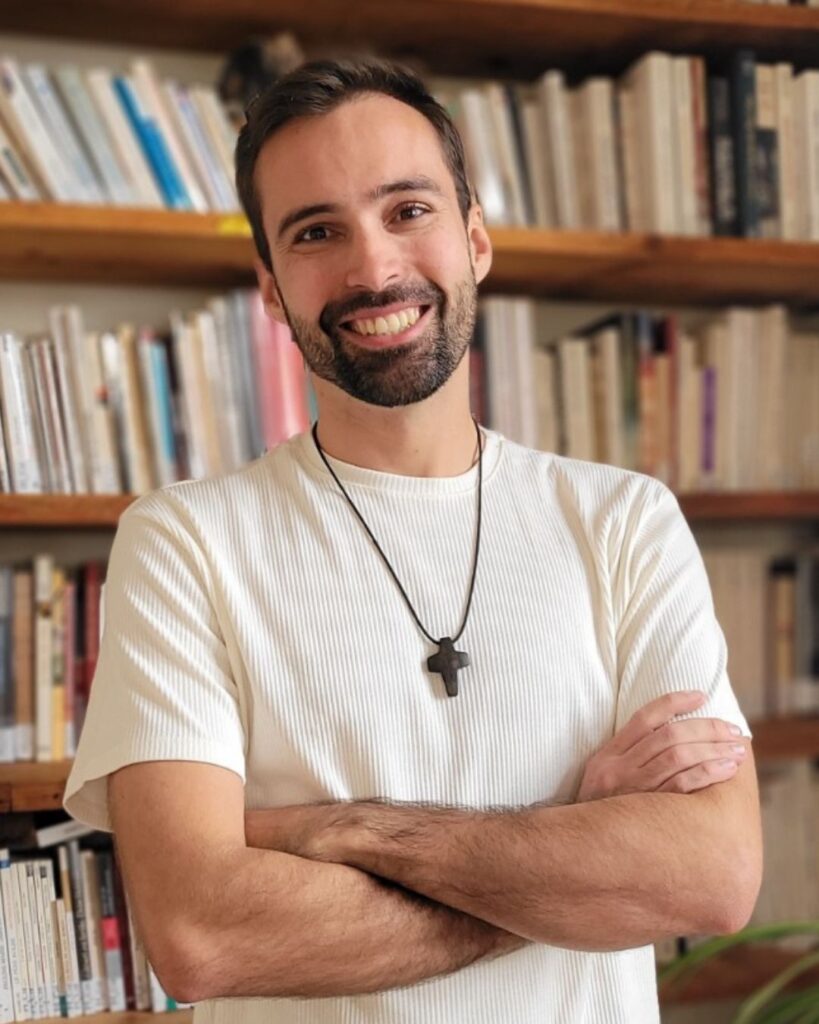
Diógenes Fonseca Lima is Brazilian. He lives in Lyon at the Henri IV residence, which hosts about forty students each year. Currently in charge of outreach to 18- to 30-year-olds in the region covering Southern France and the Rhône-Alpes region, he has committed his life to the Chemin Neuf community as a consecrated celibate.
Why are you making a lifelong commitment to the Chemin Neuf community?
When I think about making a lifelong commitment, I see it as a continuation of my first commitment, almost 15 years ago. When I made that first commitment, I didn’t think of it as a trial or a test. Committing to the community was already a total commitment, especially given what I had left behind: my country, my family, and everything I had at home. I was already committing myself with the perspective of a definitive gift to the Lord. I believe that a lifelong commitment today simply makes public a decision I had already carried in my heart from the beginning—that of making myself available to the Lord.
How did your desire to get involved come about?
It began with an admiration for the beauty of this shared life within the community: putting everything in common, being together for the mission. But what really prompted me to take a stand and commit myself wholeheartedly was a dream I had during my formation at Hautecombe Abbey. I had dreamed of a life where I possessed everything I had ever desired. Yet, at the end of that dream, I felt a kind of bitterness. Not the bitterness of having everything I wanted, but of realizing that these things were leading me away from God. So I asked myself what was important to me, what direction I wanted my life to take? That is how I found the courage to ask to enter “Nazareth, ” which is a journey of discernment, to do my novitiate in the community, to order my life to Him, to move in the direction where I would find Him.
How did you receive that call?
This calling didn’t happen overnight; it grew out of my desire to give of myself and my desire for a life shared with others. I still remember, in Brazil, at the parish house: there was a family living there with their children, along with some brothers and sisters. I used to say to my friends, “It’s amazing what they’re going through; I really want to live that way, sharing everything like that.” They told me it was strange. But that was the moment I understood deep down that there would come a time in my life when I would have to choose between the life I had and that life.
Then, when I came to France to live in community, undergo training, and perform my service, I experienced moments when that calling was confirmed time and again, through more concrete events and a deeper sense of certainty.
Finally, during the 30-day Ignatian retreat in silence, the desire that remained in my heart was that of complete openness to His love. For I had come to realize, in the end, that I had been loved first: my calling is a response to that first love.
What aspects of community life give you a sense of fulfillment?
I believe there are three things that drive my commitment.
Brotherhood first. Being with brothers and sisters often challenges me to recognize otherness—something that calls me outside of myself, to become aware of the existence of others. It upsets and unsettles me, but it also calls me to life and prevents me from settling into my comfort zone. At the same time, this fraternity supports me, walks alongside me, and often shows me the right direction.
Then there is ministry. This longing to give myself completely to proclaim the Lord has helped me grow by confronting me with my own limitations. It also became a place where the Lord came to meet me to tell me that, in my weaknesses and insecurities, He is my God, who empowers me and walks with me. Service has truly become for me a place where God is revealed.
Finally,ecumenism is something that fits very well with my personal history. At the time of my conversion, the defining encounter I experienced was with a Protestant woman. She spoke to me about Jesus for the first time as a living God who came to meet me where I was, while also being able to point out the wrong paths I was taking. When I encountered the community and this desire to evangelize together with brothers and sisters from other Christian denominations, I realized that this was where I belonged.
Translated by artificial intelligence